
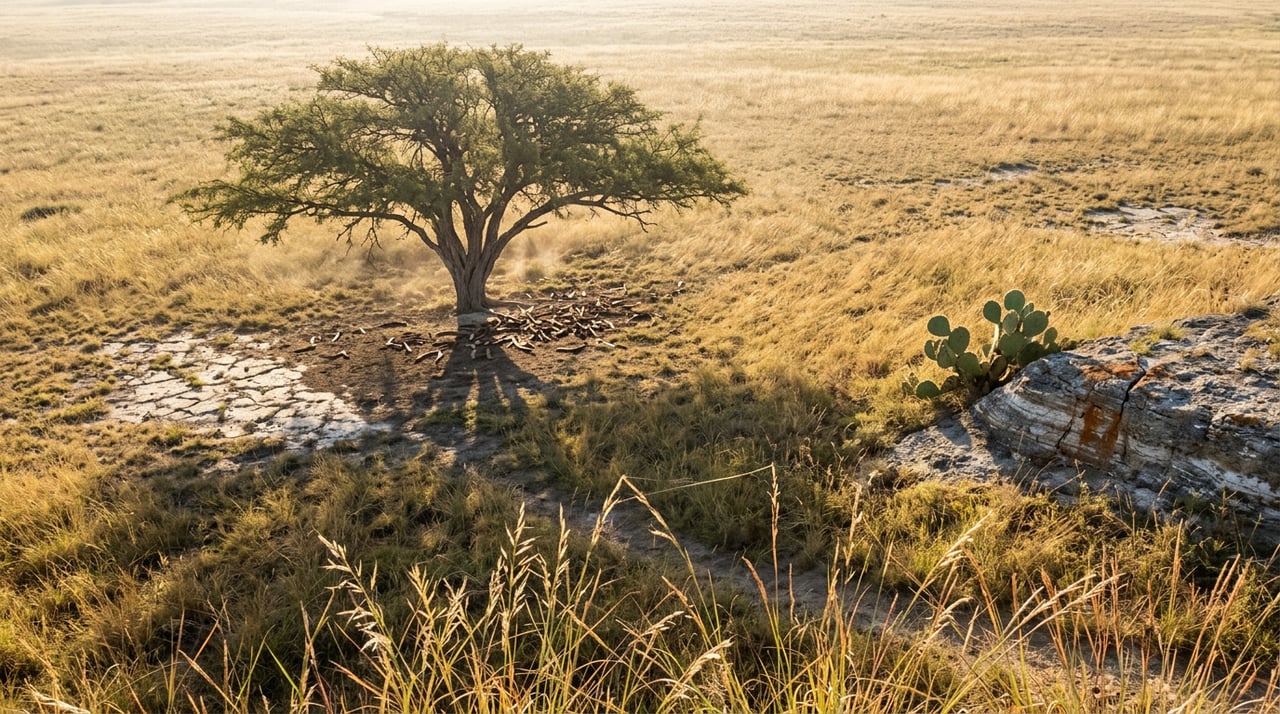
Ask four different sources what an acre of land near Lawn, Texas costs, and you will get four different answers, sometimes three times apart from each other. That is not a data error. It is the first thing anyone comparing acreage in this corner of Taylor County needs to understand before they get attached to a number they saw on a listing site.
The second thing they need to understand is buried underground, and it has nothing to do with price. It is whether a septic system will actually work on the parcel they are looking at, because a common piece of folk wisdom about Texas land, that ten acres means no rules, has led more than one buyer into a permitting problem they did not see coming.
Lawn sits about 24 miles south of Abilene, a small unincorporated community that shows up on the map at the junction of U.S. Highway 84 and Farm Road 604. Land here does not trade like a subdivision lot. It trades like acreage everywhere in rural Texas trades: on soil conditions, road access, and legal status as much as on comparable sales. Here is what that actually means for someone comparing tracts.
Texas law does carve out a possible exemption from septic permitting for a single-family home on a tract of 10 acres or larger. The catch is that the exemption only applies if the entire septic system sits at least 100 feet from every property line and all wastewater stays on the property. Soil that drains poorly can still force an engineered aerobic system regardless of how many acres surround the house.
Taylor County does not leave this to chance. The county's Environmental Department requires an on-site sewage facility permit for new installations, repairs, and alterations across the county, and any variance from the standard rules has to come from that office specifically, not from a builder, a seller, or a general assumption about acreage.
Practically, this means the first call on any raw tract near Lawn should go to the county, not to a lender. A site evaluation before an offer tells a buyer whether the land can support the home they want to build, and at what cost. A site evaluation after closing tells them the same thing, just with far less leverage.
A lot of acreage near Lawn changes hands informally, a family carving off a few acres for a son or daughter to build on. Texas Local Government Code 232 does not care that it is a family transaction. Any owner outside city limits who divides a tract into two or more parts has to have the subdivision platted, and Taylor County's own subdivision regulations spell out the roadway, drainage, and bonding requirements that come with it.
There is a smaller cousin of this rule that trips people up during construction. New driveway or culvert access onto a county road requires a permit from Taylor County Road and Bridge, currently priced at $25, along with 24-hour advance notice before work begins. It is a modest fee, but it is also one of those details that surfaces during a title search or a construction loan draw and stalls a closing timeline when nobody planned for it.
None of this makes land near Lawn harder to buy than land anywhere else in rural Texas. It makes the paperwork sequence matter more than the price tag, which is a different kind of due diligence than most buyers bring from a subdivision purchase.
Here is where the confusing part of "what does land near Lawn cost" actually comes from. Every source pulling from Taylor County reports a real number. They are just measuring different slices of the same market.
| Source | What it measures | Average price per acre |
|---|---|---|
| Sold land records, Taylor County | Closed sales of farmland, ranches, and pasture | around $8,698 median |
| Active farmland listings, Taylor County | Land currently marketed for agricultural use | around $13,039 |
| Active residential land listings, Taylor County | Vacant tracts marketed as homesites or acreage | around $23,704 |
| All active land listings, Taylor County | Every land listing type combined | around $26,842 |
Read down that table and the pattern is not random. The number climbs almost every time the definition narrows toward land someone can actually put a house on. A countywide sold-land median leans on ranch and pasture parcels that traded for agricultural value, the kind of ground bought to run cattle or hay rather than to build on. Once you isolate listings marketed specifically as buildable residential acreage, the number nearly triples, because buildability, not location alone, is what the price is paying for.
This is the trap. Someone who quotes "land near Lawn runs about $9,000 an acre" and someone who quotes "about $27,000 an acre" might both be right, and both might be describing land that is functionally useless to the other person's plans. The question that matters is not what the average acre costs. It is which of these categories the specific tract in front of you actually belongs to, and whether the septic and platting questions above have already been answered for it.
If price per acre is the wrong number to fixate on, what is the right one? Look at what Jim Ned Consolidated Independent School District, which serves Tuscola, Buffalo Gap, and Lawn, has actually spent money building.
In 2020, district voters approved a bond that funded Jim Ned Intermediate School on Highway 83, built to relieve overcrowding that had been building at the elementary campuses in Lawn and Buffalo Gap. By 2023, the district was back on the ballot, this time because Jim Ned High School itself had run out of space. On November 7, 2023, voters narrowly approved a $23.5 million bond, Proposition A, by a 51 percent to 49 percent margin, for new school buildings. A companion $4.8 million proposition for a performing arts auditorium failed by a similar margin.
Superintendent Dr. Glen Teal told local reporters at the time that a home valued at $150,000 would see roughly a $50 increase in annual property taxes as a result of the bond, a figure that climbs with the home's value.
A district does not propose two capacity-building bonds in three years, and pass one narrowly amid visible tax pushback, unless enrollment pressure is real rather than a talking point. That is a more reliable growth signal for someone evaluating Lawn than any single per-acre average, because it reflects families who have already moved in and need a desk for their kids, not speculation about who might move in next.
Put these pieces together and the picture for anyone comparing acreage near Lawn looks like this. The area has a genuine, documented pattern of family in-migration strong enough to force two school bonds in three years. That is real demand. But the price you should expect to pay for a given tract depends heavily on whether it is raw pasture, listed farmland, or a residential-ready homesite, and whether someone has already confirmed it can support a septic system and, if it needs to be divided, a legal plat.
A short list worth working through before writing an offer:
None of this is legal or financial advice, and county requirements can shift, so the county's own offices are the final word on any specific parcel.
Land near Lawn rewards buyers who ask the underground questions before they ask about the sticker price. The Kristen Dressen Kyker Team at Coldwell Banker Apex, Realtors has been walking Big Country buyers through exactly this kind of acreage and land transaction, from septic feasibility to platting status, for years across Abilene, Buffalo Gap, Tuscola, and the surrounding communities. If you are comparing a tract near Lawn against options elsewhere in the Big Country, reach out and we will help you figure out what the land in front of you actually costs, not just what the average says it should.
Does owning 10 acres near Lawn guarantee I can skip a septic permit? Not automatically. The tract has to meet setback and effluent requirements, and Taylor County's Environmental Department is the only office that can grant a variance if soil or other conditions require a different system.
If my family wants to give me a few acres off their land near Lawn, do I need to plat it? Generally yes. Texas law requires a plat whenever a tract outside city limits is divided into two or more parts, regardless of whether money changes hands.
Does the Jim Ned CISD bond news mean land prices near Lawn will keep rising? It is evidence that families are actually moving into the district, which is a stronger signal than a listing price alone. It is not a guarantee about future appreciation, and any specific parcel still needs its own due diligence on access, septic feasibility, and platting status.
Who you work with matters! When it comes to your real estate needs, you should work with the best. Whether it is buying, selling, renting, second homes, investing, or more, we are happy to help assist you in any way that we can.

2500 S Willis St Abilene, TX 79605