
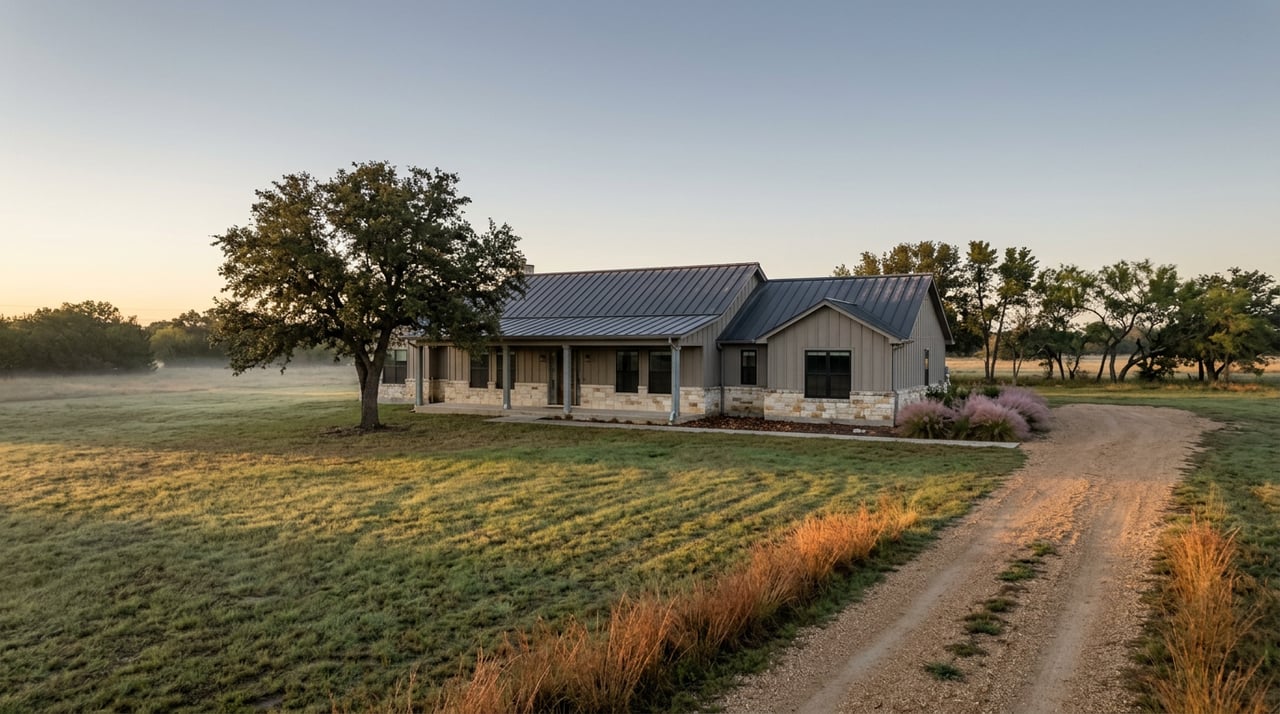
Two properties can share a mailing address of Ovalo, TX 79541, sit less than a mile apart off the same farm-to-market road, and send children to two entirely different school districts. One parcel gets marketed as part of the Jim Ned Consolidated Independent School District. The next tract over, same road, same ZIP code, gets listed as Wylie ISD. Nothing on the envelope, the county tax notice, or the listing headline tells you which one you're looking at until someone actually checks.
That gap between the address and the district line is the thing worth understanding before you fall for a photo of a stock tank and a rolling pasture. Ovalo is not a town in the incorporated sense. It's an unincorporated community in Taylor County built around the intersection of Farm Road 614 and U.S. Highway 83, and the postal designation covers a lot more ground than most buyers assume. That geography matters more here than it would in a platted subdivision, where every lot inside the fence line belongs to the same school and the same HOA. In Ovalo, the mailing address is a convenience for the post office. It was never meant to answer a real estate question.
Search listings tagged with an Ovalo mailing address and you'll find acreage described as being in Jim Ned CISD sitting a short drive from acreage described as being in Wylie ISD, both inside the same 79541 ZIP code. Jim Ned CISD is headquartered in Tuscola and serves the Buffalo Gap and Ovalo area, and it shows up again and again in listing language as the district buyers specifically ask for. Wylie ISD, based closer to Abilene proper, reaches out into parts of the same rural stretch of Taylor County. The Texas Education Agency is clear that school district boundaries and postal geography are two separate systems entirely, and TEA's own guidance notes that its maps are approximations useful for general information but not for legal or commercial transactions. In other words, the agency that draws the lines tells you outright not to trust a general map for a real decision.
For a buyer, that means the phrase "Ovalo, TX" on a listing sheet is not a promise. It's a starting point. The only way to know which district actually serves a specific parcel is to check that parcel, not the town name attached to it.
This isn't a footnote for people who care about schools in the abstract. Jim Ned CISD gets described in listing after listing as the draw, the reason a buyer is looking at a particular tract instead of the one down the road. When a district's name is doing that much marketing work, the boundary between "in it" and "not in it" is worth more than a passing glance.
The second thing the address hides is what you're actually paying for per acre, because the number that gets quoted for Ovalo land averages together properties that have almost nothing in common.
As of this year, the average asking price across all Ovalo-area land listings works out to roughly $14,566 per acre. But when you isolate ranch-scale tracts specifically, the average cost to buy drops to about $9,907 per acre. That's not a rounding difference. It's two markets getting reported as one.
Here's what's driving the split. A 500-acre ranch tract, the kind advertised near the Graham Lake area with hundreds of acres of pasture and multiple stock tanks, sells for a lot of money in total but a modest number per acre, because size dilutes price. A 7 to 10 acre tract with highway frontage on US 83, positioned for a homesite or light commercial use, commands a premium per acre because road access and buildability matter more than raw square footage. Blend those two products into one "average price per acre for Ovalo" and you get a number that describes neither buyer's actual experience.
| Tract type | Typical scale | What drives the price | Rough price per acre |
|---|---|---|---|
| Ranch or recreational acreage | 100+ acres | Total acreage, water features, hunting value | Around $9,900 |
| Highway-frontage or homesite tract | 5 to 15 acres | Road access, utility availability, buildability | Well above the blended average |
If you're comparing "the price of land in Ovalo" to a number you saw for Tuscola or Buffalo Gap, you need to know which side of that split you're actually shopping. A buyer looking for a homesite close to town is not competing in the same pool as a buyer looking for four hundred acres to run cattle, even though both listings might carry the same city name.
For context, the typical home value across Ovalo currently sits around $385,930, based on live market data pulled this month. That figure sits closer to Tuscola's home values than to smaller Taylor County towns like Merkel or Lawn, which tracks with what the land data suggests: Ovalo's residential and near-town tracts are pricing more like an extension of the Tuscola and Buffalo Gap corridor than like open ranch country, even though plenty of genuine ranch acreage still carries the same mailing address.
New subdivision activity backs this up. Development marketed under names like Wild Horse Trails sits specifically in the Tuscola and Jim Ned ISD footprint, offering half-acre lots with city water, fiber internet, and no HOA. That's a very different buying decision than a 40-acre tract off County Road 194 with a completed feasibility study and no subdivision restrictions at all. Both might show up in a search for "Ovalo land." Only one of them is actually a starter-home lot.
The takeaway isn't that one product is better. It's that "Ovalo" as a search term flattens a real distinction between a rural homesite market, a ranch and recreational land market, and a small but real subdivision market, and a buyer who doesn't separate those three is comparing prices that were never meant to be compared.
A few habits protect you from all of this.
First, verify the specific school district for the parcel, not the town. The Texas Education Agency's School District Locator lets you check a specific address against district boundaries, and it's a better first step than trusting a listing description that says "Jim Ned schools" without a parcel number attached.
Second, ask what's actually driving the per-acre price on any specific tract before you compare it to another listing's per-acre number. A high price per acre on a small tract isn't a red flag if that tract has highway frontage and utilities already in place. A low price per acre on a large tract isn't automatically a bargain if most of that acreage is unusable pasture with no road access.
Third, treat "Ovalo" as a starting point for a conversation, not a finished search. The community spans multiple school districts, multiple land products, and a wide range of what "buildable" actually means on any given parcel. The name on the mailbox won't sort that out for you.
Does my ZIP code determine which school district I'm zoned to? No. ZIP codes are a postal system built for mail delivery. School district boundaries are drawn separately under state law, and TEA maintains that its maps are for general reference only, not for legal or commercial decisions. The only reliable way to confirm a district is to check the specific parcel.
If my property sits near a district boundary, can I request a transfer to the other district? Texas law allows districts to enter transfer agreements, and a receiving district may charge tuition where permitted. This is a conversation to have directly with both districts involved before you assume it's an option, since arrangements vary and aren't guaranteed.
Where do I check a specific parcel's district before I make an offer? Start with TEA's School District Locator for a general boundary check, then confirm directly with the district office and cross-reference against the Taylor County Appraisal District, since TEA's own maps note they aren't precise enough for a transaction.
Ovalo rewards buyers who ask the second question instead of stopping at the first one. If you're comparing this stretch of Taylor County to Tuscola, Buffalo Gap, or anywhere else in the Big Country and want someone who'll walk the actual parcel lines with you instead of the marketing copy, The Kristen Dressen Kyker Team knows this ground well enough to tell you which side of the boundary you're really standing on. Contact us.
Who you work with matters! When it comes to your real estate needs, you should work with the best. Whether it is buying, selling, renting, second homes, investing, or more, we are happy to help assist you in any way that we can.

2500 S Willis St Abilene, TX 79605